
Writing
Writing in the Curriculum at St Mark’s
We believe that writing is a vital life skill which enables children to communicate ideas, emotions and experiences effectively. At our school, we aim to develop confident, creative and purposeful writers who understand the importance of audience, purpose and genre and every child can become a successful writer.
Our writing curriculum
Our writing curriculum is:
- carefully sequenced from the Early Years through to Year 6, with clear progression in line with the National Curriculum and regular internal and external professional development.
- ambitious, inclusive and progressive, ensuring all pupils are supported and challenged to achieve their full potential.
- taught through engaging texts and meaningful experiences, children develop the knowledge and skills needed to write clearly, accurately and imaginatively for a range of purposes and audiences.
- closely linked to our reading curriculum, as we believe that exposure to rich vocabulary, high-quality texts and diverse authors inspires children and strengthens their understanding of language.
- linked to oracy, discussion and shared experiences, pupils develop confidence in expressing ideas before applying them in writing.
- linked to our core values of community, achievement, respect and empathy. We encourage children to be brave, reflective and creative writers who understand the power of communication and take pride in their work.
Writing in EYFS
Our aim is to develop confident communicators who see themselves as writers and enjoy expressing their ideas and in the Early Years, children begin their writing journey through rich language experiences, purposeful play and meaningful opportunities to communicate through:
- Access mark-making opportunities across the indoor and outdoor provision.
- Develop the fine and gross motor skills needed for successful writing.
- Engage in storytelling, role play and oracy activities to develop language and imagination.
- Participate in daily phonics teaching to support early transcription and handwriting.
- Orally rehearse ideas before writing, building confidence and sentence fluency.
- Experiment with drawing, mark making and early writing to communicate meaning.
- Build vocabulary through high-quality texts, conversation and play.
- Develop correct letter formation and early handwriting habits.
- Begin to write words and simple sentences using their growing phonic knowledge.
- Receive timely support and challenge through ongoing observation and assessment.
Develop confidence, independence and enjoyment as early writers.
Children are encouraged to communicate their ideas confidently and develop a love of writing from the very beginning, creating strong foundations for future success in writing.
Writing in Year 1
In Year 1, pupils build on the strong foundations established in the Early Years through a balance of direct teaching, structured practice and purposeful opportunities to write within continuous provision. Children will build on the communication, language and early writing skills developed in the Early Years through:
- Access continuous provision that provides meaningful opportunities for writing across the curriculum.
- Shared writing sessions which focus on sentence construction through oral rehearsal, storytelling and discussion.
- Practising oral composition with the opportunity to re-read and improve their writing with support from adults and peers.
- Applying phonics knowledge to spell words and compose simple sentences independently.
- Learning and practicing correct letter formation and handwriting skills.
- Write for a range of purposes and audiences through engaging, meaningful contexts.
- Develop vocabulary through high-quality texts, talk and shared experiences.
- Build stamina for writing through regular opportunities to write at length.
- Receive targeted support and challenge through ongoing assessment and responsive teaching.
- Develop positive attitudes towards writing and see themselves as successful writers.
Through carefully planned teaching and purposeful provision, pupils develop the skills, knowledge and confidence needed to become independent writers and make a successful transition into Key Stage 1 writing expectations.
Writing across the school
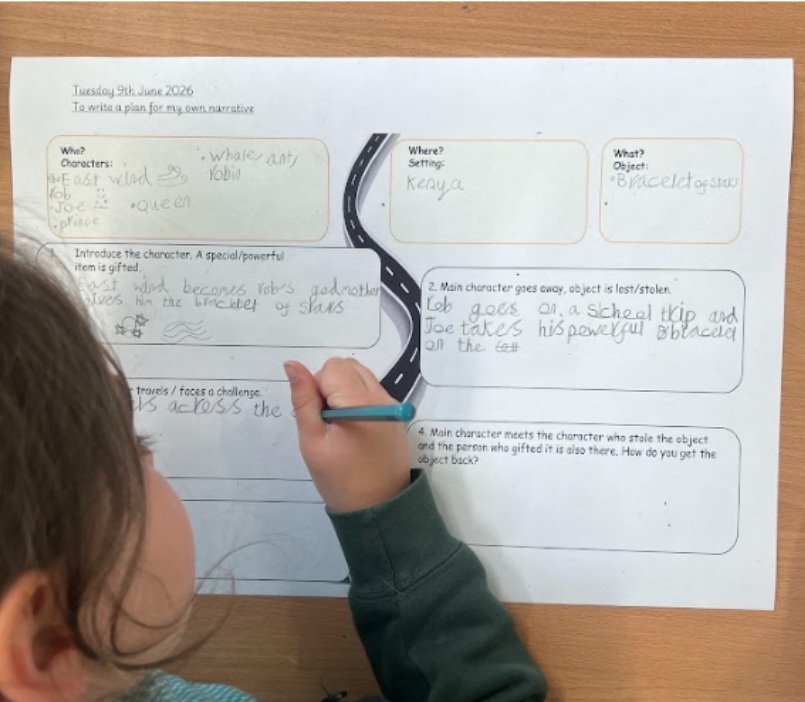
Writing is typically taught through a structured three-week sequence built around a high-quality core text, often linked to wider curriculum learning.
During the sequence, pupils:
- Become immersed in a text through reading, discussion and oracy activities.
- Explore the author’s language and writing choices.
- Learn and apply grammar, punctuation and vocabulary in context.
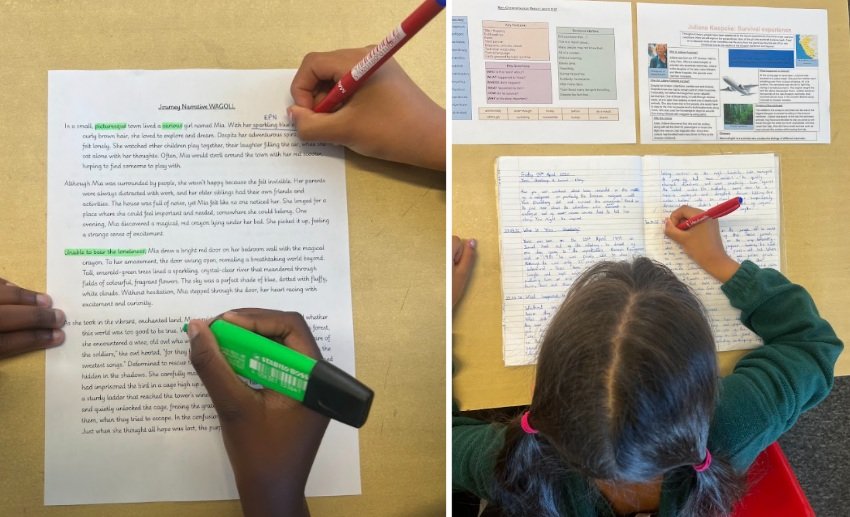
- Analyse a WAGOLL (What A Good One Looks Like) to identify key features and techniques.
- Consider audience, purpose and intended effect before planning writing.
- Take part in shared writing sessions where teachers model the writing process.
- Write independently with increasing confidence and creativity.
- Edit, improve and publish their work, celebrating successful writing.
We place a strong emphasis on purposeful writing so that children understand:
- Who they are writing for
- Why they are writing
- How language choices create an impact on the reader.
Children are given opportunities to apply writing skills across the curriculum and through meaningful experiences. Diverse and inclusive texts ensure all pupils feel represented and develop understanding of different cultures, perspectives and experiences.
Inclusion and Support
We are committed to ensuring all children achieve their potential in writing. Teachers adapt support and challenge to meet the needs of all learners, including SEND pupils and those working at greater depth.
Support may include:
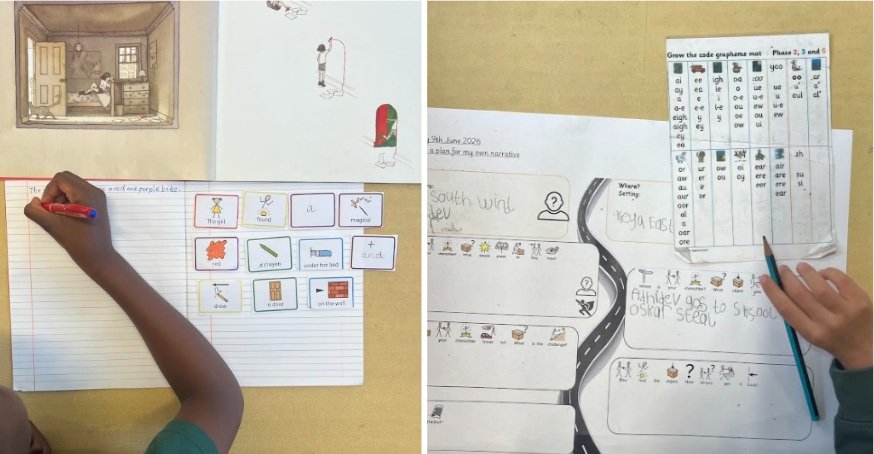
- Visual prompts and word banks
- Sentence starters and scaffolded planning
- Colourful Semantics
- Small group support and targeted intervention
- Oral rehearsal and discussion before writing
Greater depth writers are encouraged to experiment with language, structure and authorial choices to further develop creativity and independence.
By the end of EYFS
By the end of EYFS, we want children to:
- Confidently communicate ideas through talk, play, mark making and early writing.
- Develop fine and gross motor skills needed for successful handwriting.
- Hold a pencil correctly and form recognisable letters.
- Use their growing phonics knowledge to write sounds, words and simple sentences.
- Begin to write independently for a range of purposes within play and adult-led activities.
- Orally rehearse sentences before writing them.
- Develop stamina and confidence in recording their ideas.
- Use vocabulary from stories, experiences and discussions in their writing.
- Show enjoyment, curiosity and creativity when mark making and writing.
- Take pride in their work and begin to understand that writing communicates meaning to others.
By the end of KS1
By the end of KS1, we want children to:
- Write simple, coherent sentences for different purposes.
- Use phonics knowledge to spell many words accurately.
- Form letters correctly and begin to use joined handwriting.
- Sequence ideas logically in their writing.
- Use basic punctuation correctly, including capital letters and full stops.
- Develop stamina and confidence when writing independently.
- Discuss and rehearse ideas aloud before writing.
- Show creativity and enjoyment in writing.
By the end of Year 6
By the end of Year 6, we want children to:
- Write effectively for a range of purposes and audiences.
- Adapt language and structure appropriately for different genres.
- Use ambitious vocabulary and grammatical structures to create impact.
- Organise writing coherently using paragraphs and cohesive devices.
- Edit and improve writing independently.
- Write with increasing fluency, stamina and accuracy.
- Apply spelling, punctuation and grammar knowledge confidently.
- Take pride in presentation and maintain legible joined handwriting.
- Use writing to communicate ideas thoughtfully, creatively and effectively.
How to support your child at home
- Read regularly with your child and discussing books together.
- Encourage children to talk about their ideas before writing.
- Provide real-life writing opportunities such as shopping lists, cards, letters or journals.
- Practice weekly spellings and handwriting.
- Encourage children to use adventurous vocabulary in conversation and writing.
- Support children to write for different purposes, such as stories, instructions or recounts.
- Celebrate creativity, effort and improvement in writing.
Curriculum Books
Quick links to our Curriculum books for all year groups from Nursery to Year 6.
Year Groups
From Nursery to Year 6 – find out all the information relevant to your child’s year group.
Whole School News
School news and events, letters to parents, dates for your diary, information and announcements.