
Reading
Reading at St Mark’s
In accordance with the National Curriculum, we believe that reading is a fundamental life skill which opens the door to learning, imagination and understanding the world. At St. Mark’s, we aim to develop confident, fluent and thoughtful readers who enjoy reading for both purpose and pleasure. Our carefully sequenced curriculum enables pupils to develop strong decoding, fluency and comprehension skills while fostering a lifelong love of reading.
Our goal is for every child to leave St. Mark’s as a confident, fluent and enthusiastic reader who can use reading to learn, think critically and engage with the world around them.
Our Reading curriculum
At St Mark’s our reading curriculum:
- Follows a carefully sequenced reading curriculum that builds progressively from the Early Years to Year 6.
- Teaches early reading through a systematic phonics programme supported by high-quality reading materials.
- Uses whole-class reading lessons to expose pupils to a broad and balanced range of high-quality texts.
- Studies carefully selected core texts that engage pupils, broaden experiences and support wider learning.
- Explicitly teaches vocabulary, comprehension and reading strategies.
- Develops understanding through discussion, questioning and rich oracy opportunities.
- Encourages pupils to explain their thinking and justify responses using evidence from the text.
- Explores authors’ language choices, literary techniques and themes across a range of texts.
- Promotes fluent, expressive reading through regular opportunities to read aloud.
- Use ongoing assessment to identify strengths, misconceptions and next steps in learning.
- Provides targeted support and challenge to ensure all pupils achieve success as readers.
How Reading is taught at St Mark’s
Once children have developed secure decoding and fluency skills, typically during Year 2, they move to our whole-class reading approach. This exposes pupils to a broad and balanced range of high-quality texts, enabling them to develop fluency, comprehension, vocabulary and a love of reading.
These texts include:
- Fiction and chapter books
- Poetry
- Non-fiction texts
- Diverse authors and perspectives
- Texts linked to wider curriculum learning
Each class studies a carefully selected core text, usually a chapter book, which is read from beginning to end. These texts are chosen to engage pupils, broaden experiences and support wider curriculum learning and writing outcomes.
During reading lessons, pupils:
- Discuss the impact of language and why authors have made literary choices
- Identify and explore literary techniques
- Compare themes, characters and ideas across texts
- Develop understanding of unfamiliar vocabulary
- Infer characters’ thoughts, feelings and motives using evidence from the text
- Make predictions and summarise key events and ideas
- Answer comprehension questions using evidence to justify responses
Oracy is central to our reading curriculum. Children regularly discuss texts, share opinions and rehearse responses aloud to deepen understanding and confidence.
Reading aloud is actively promoted across the school. Pupils are encouraged to read with fluency, expression, volume and tone to develop comprehension and enjoyment.
Inclusion and support
We are committed to ensuring all children achieve their potential in reading. Teaching is adapted to support all learners, including SEND pupils and those working at greater depth.
Support may include:
- Pre-teaching vocabulary
- Visual prompts and scaffolded questioning
- Small group support and targeted intervention
- Additional opportunities for reading aloud and oral rehearsal
Greater depth readers are encouraged to think critically, make deeper connections within and between texts and justify interpretations using evidence.
Reading in EYFS
In the Early Years, children begin their reading journey through rich language experiences, daily phonics teaching and a love of stories. Our aim is to develop confident communicators and enthusiastic early readers who enjoy books and language.
- Participate in daily phonics sessions that develop early decoding skills.
- Enjoy storytelling, nursery rhymes, songs and high-quality story times.
- Learn in language-rich environments that promote speaking, listening and vocabulary development.
- Develop communication and comprehension skills through play, discussion and adult interaction.
- Share books regularly to develop enjoyment, understanding and curiosity.
- Begin to recognise and use phonics knowledge to decode simple words.
- Retell familiar stories and talk confidently about books, characters and events.
- Build vocabulary through stories, conversation and meaningful experiences.
- Develop early reading behaviours, including book handling, prediction and discussion.
- Grow in confidence as readers and communicators, building strong foundations for Key Stage 1.
By the end of EYFS, we want children to:
- Enjoy sharing and listening to stories, poems and rhymes.
- Develop confidence in speaking about books and characters.
- Recognise and use phonics knowledge to decode simple words.
- Begin to read simple sentences with increasing fluency.
- Retell familiar stories and discuss key events.
- Develop early comprehension skills through discussion and questioning.
- Build vocabulary through stories, play and conversation.
- Show curiosity, enjoyment and confidence when reading.
Reading in Key Stage 1
In Key Stage 1, pupils build on the foundations established in the Early Years through our Little Wandle Letters and Sounds Revised programme. Our aim is for every child to become a fluent, confident reader who enjoys reading and can access the wider curriculum independently.
- Participate in daily phonics lessons that build secure decoding and word-reading skills.
- Read fully decodable books that are carefully matched to their phonics knowledge.
- Take part in structured reading practice sessions focusing on decoding, prosody (reading with expression) and comprehension.
- Re-read familiar texts to develop fluency, confidence and automaticity.
- Receive timely keep-up support where needed to ensure they keep pace with the programme.
- Develop vocabulary and comprehension through discussion, questioning and shared reading.
- Read and discuss a range of fiction, non-fiction and poetry texts.
- Make predictions, discuss characters and retell stories and key events.
- Answer questions about texts and begin to justify responses using evidence.
- Build confidence in sharing opinions and responding thoughtfully to books.
- Experience a wide range of high-quality texts that broaden knowledge and understanding of the world.
- Develop positive attitudes towards reading and a lifelong enjoyment of books.
By the end of KS1, we want children to:
- Read accurately and fluently using phonics knowledge.
- Develop confidence and enjoyment when reading aloud.
- Discuss books and make simple predictions.
- Explain vocabulary and identify key features in texts.
- Answer questions about what they have read using evidence.
- Retell stories and summarise key events.
- Read a range of fiction, non-fiction and poetry texts.
- Develop positive attitudes towards reading.
Reading in Key Stage 2
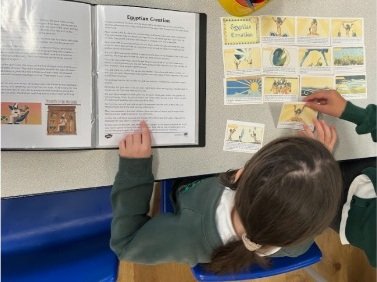
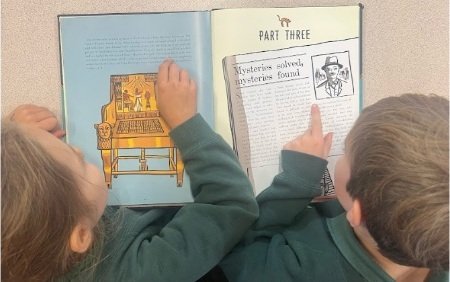
In Key Stage 2, pupils build on the fluency and decoding skills developed in Key Stage 1 to become thoughtful, knowledgeable and independent readers. Through our whole-class reading approach, pupils engage with rich, challenging texts and learn to read closely, think critically and discuss their ideas using evidence from the text. Our aim is for every child to develop a lifelong love of reading and the knowledge and vocabulary needed to succeed across the curriculum.
- Study high-quality whole texts, including fiction, non-fiction and poetry.
- Read complete texts rather than extracts wherever possible, developing stamina and engagement as readers.
- Explore ambitious vocabulary and understand how authors use language to create meaning and effect.
- Develop background knowledge and understanding of the wider world through carefully selected texts.
- Discuss texts in depth, sharing ideas and responding thoughtfully to the views of others.
- Use evidence from the text to justify opinions, interpretations and conclusions.
- Explore themes, characters, settings and authorial choices through rich discussion and questioning.
- Develop understanding through re-reading, close reading and text-based analysis.
- Make connections within and between texts, drawing on prior knowledge and wider reading.
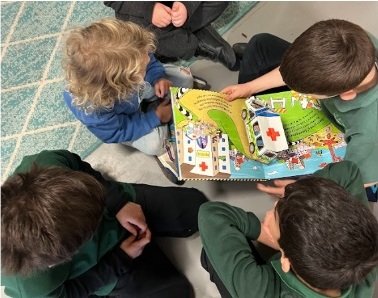
- Build fluency and comprehension through regular opportunities to read aloud and listen to expert reading.
- Experience a diverse range of authors, genres, cultures and perspectives.
- Develop independence, curiosity and confidence as readers, preparing them for secondary education and beyond.
Our curriculum places reading at the heart of learning, enabling pupils to acquire knowledge, deepen understanding and develop a genuine appreciation of literature.
By the end of KS2, we want children to:
- Read fluently and confidently across a wide range of texts.
- Explain and discuss authorial choices and literary techniques.
- Infer meaning, thoughts and feelings using evidence from the text.
- Compare themes, ideas and language across different texts.
- Summarise information clearly and accurately.
- Discuss and evaluate vocabulary and its impact on the reader.
- Read aloud with appropriate fluency, expression and intonation.
- Develop a love of reading and use reading skills effectively across the curriculum and beyond school.
You can support reading at home by:
- Reading regularly with your child and discussing texts together.
- Encouraging your child to read aloud with expression and fluency.
- Asking questions about characters, events and vocabulary.
- Visiting the library and exploring a range of books together.
- Encouraging discussion about books, authors and favourite stories.
- Listening to your child read frequently and praising effort and progress.
- Sharing poetry, non-fiction texts and stories from different cultures and experiences.
Curriculum Books
Quick links to our Curriculum books for all year groups from Nursery to Year 6.
Year Groups
From Nursery to Year 6 – find out all the information relevant to your child’s year group.
Whole School News
School news and events, letters to parents, dates for your diary, information and announcements.